Archive for 'stonecrop'

Wild Edible Notebook—July Release!

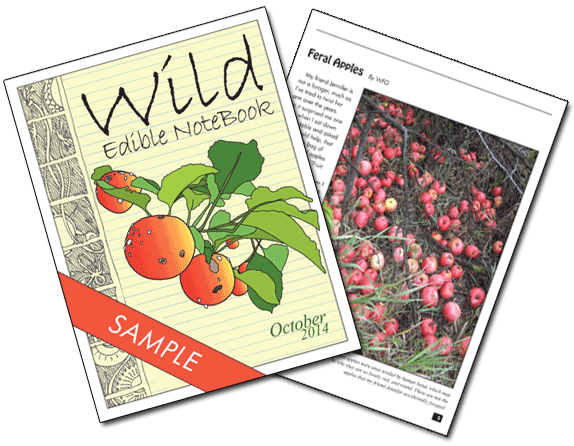
wen July 2011c cover 640 226x350 Wild Edible Notebook—July Release!Halfway through July I am honored to present the second issue of the Wild Edible Notebook, my journal-style tale of select plants. In this issue, read up on succulents including roseroot, rosecrown, and purslane. The July issue also has instructions for a few brightly-colored wild dishes as part of a new Recipes section. 

This issue differs from the first in that the entries featured are edited, updated, and otherwise revised versions of previous blog posts, rather than simple reformats. If you’ve read this blog thoroughly you might recognize some of the information; still, I hope you’ll find that the Wild Edible Notebook tells a more updated tale than the original posts, part of my journey towards figuring out exactly what form all of this writing might one day take.

Sign Up Required

The final difference between the first and second issues is that this time you have to sign up for the email list to download the notebook. By double-opting in, which is what it’s called if you go through the process to join my list, then you give me permission to email you 10,000 times a day. 

Just kidding. I will probably email once or twice a month—once to alert you about the newest edition of the Wild Edible Notebook and give you a download link, and perhaps one other time with announcements that are hopefully of interest to you, regarding classes, food swaps, sweet deals on wild food merchandise, and things of that matter. You can also unsubscribe whenever you want.

Without further ado, then, it’s time for the call to action: Scroll all the way to the bottom of this page to sign up. Within minutes, you’ll receive an email asking for you to click on a confirmation link, and after doing that, you’ll get another email with the download link for the July issue of the Wild Edible Notebook—in your choice of either a handy print-and-fold booklet or a file you can breeze through onscreen or print out one-sided. Cheers!

Sweet Pickling Succulents

roseroot 350x262 Sweet Pickling Succulents

Roseroot with blood-red flower buds.

Succulents are juicy plants that store water in their leaves, stems, and roots, an adaptation which helps them survive in arid climates or soil conditions. Aloe, agave, sedums and purslane are some examples. 

Although “dry” is not a word I’d use to describe the high country right now, it often is dry, and so the timeless succulents are there, now sucking up this season’s water bounty and growing like crazy like everything else. 

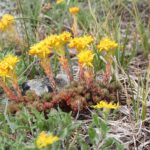
Two edible succulent plants I collect at 10,000 feet in the Colorado Rockies are stonecrop and roseroot / rosecrown (the latter in fact being two related plants that look similar and grow in proximity to one another.) 

All of these plants are thriving right now—although I don’t know if that’s a good thing or a bad thing. 

Read the rest of this entry

Roseroot is Edible, Who Knew?

roseroot flowering 350x262 Roseroot is Edible, Who Knew?

What I believe to be roseroot, or Sedum rosea.

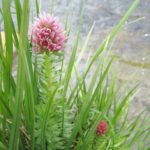
I first noticed roseroot on a high-country hike above Fairplay, Colorado as Gregg and I were scrambling up a rock face, off-trail as usual. The plant is distinctive and attractive—tiny, blood-red flowers atop a fleshy stalk with spirally overlapping (Peterson, 1977) succulent, white-green leaves—and so I photographed it to look up later in Plants of the Rocky Mountains, a flora identification guide we obtained recently from The Printed Page bookshop in Denver.

Plants of the Rocky Mountains by Linda Kershaw, et. al. (1998) is not specific to edible wild plants, but when I found the plant in question in the picture index followed by the entry, lo and behold, I also discovered that our local roseroot is edible. (A quick perusal of the new guide revealed that edibility information is included for many of the plants, to my very pleasant surprise. Come to find out that Linda Kershaw also authored Edible and Medicinal Plants of the Rockies, a guide I have yet to obtain.) What luck!  Read the rest of this entry