Book look: Edible Wild Plants by John Kallas

Edible Wild Plants 232x350 Book look: Edible Wild Plants by John KallasThere’s a telltale photo of author John Kallas, Ph.D, in his 2010 book, Edible Wild Plants: Wild Foods from Dirt to Plate (Gibbs Smith). It’s a faded, 1973 shot of the then long-haired, bearded forager emerging from a swamp wielding cattail vegetables. John Kallas is the real deal. He’s been at the wild edible game a long time; he knows his plants well and has years of experience researching and eating them.

A visually appealing, glossy 400-page book with full-color photographs, Edible Wild Plants is the first in a planned multi-part Wild Food Adventure Series from Kallas, who founded the Portland, Oregon based Institute for the Study of Edible Wild Plants and Other Foragables and its educational branch, Wild Food Adventures (www.wildfoodadventures.com).

The author is a salad lover, judging by all the salad ideas in the book. He also enjoys putting wild edible greens on sandwiches and adding them to myriad other recipes. So it makes sense that Kallas’ first book should centers on greens—specifically, wild leafy greens that love disturbed soil zones.

For readers with farmland, gardens needing weeding or overgrown lots that they hope to forage, Kallas’ book is a superb resource.

In keeping with the current trend among wild edible authors to provide more detailed accounts of less plants (in contrast to traditional identification guides) Edible Wild Plants includes for each plant a detailed and thorough chapter featuring stories of the author’s experience, plant descriptions, photographs of growth stages, and food preparation ideas.

Read the rest of this entry

A sumac and angelica summer cocktail in winter

sumac angelica 265x350 A sumac and angelica summer cocktail in winter

Tangy sumac and angelica liqueur

Just after posting my pinklog, I made something else pink by accident.

“Tangy angelica liqueur,” Gregg called it, and indeed, he guessed correctly because the base of this cocktail is a spicy angelica liqueur we made in the fall. I’ve been drinking it by itself, chilled over ice, and liking it—but not quite loving it, not like I loved the elderberry flower liqueur of this past summer, or the berry liqueurs before that.

Still, wild angelica (Angelica spp.) is a good friend of mine, one I made after much trepidation on account of how it resembles poison hemlock. This particular batch we gathered from approximately 11,000 feet in Colorado in the days just after Gregg proposed to make an honest woman of me.

Tonight, as I cleaned dishes piled in the kitchen from two days ago, I came to a saucepan of dry, abandoned sumac “berries” (Rhus glabra) from which I had extracted tea to use in a tangy butter sauce for fish, and my need for clean dishes inspired the cocktail. So I simmered the sumac leftovers down in a small amount of water to make as tangy a tea as possible, then let it cool and poured it over ice with the vodka-based angelica liqueur. Yum city. Read the rest of this entry

Pretty in wild pink

prickly pear syrup light 350x262 Pretty in wild pink

In the glow of the prickly pear syrup I see…

I don’t know why suddenly all of my wild edible concoctions are coming out hot pink—maybe it’s because pink is the color of love and it’s February? Regardless, here is some pretty-in-pink wild edible fun if you’re game:

Prickly pear & grapefruit syrup

Butter and I foraged these small, wrinkled prickly pears (Opuntia spp.) in the Denver area in fall, and every day of my time-sucking job after that they sat out on the counter, waiting for me to cook with them, until one day they were fully dried out.

Read the rest of this entry

How we ate prairie dog

White tailed prairie dog 2 350x282 How we ate prairie dog

We at prairie dogs, though I’m not certain what species. This is a white-tailed prairie dog (Cynomys leucurus) photographed in Colorado by John J. Mosesso , NBII. Licensed for reuse by Wikimedia Commons.

Allow me to fall from grace a bit and tell you about an unusual project from last summer. Until now I’ve kept mum on the subject, as my take on it ranges from awesome to repulsed, and I played an integral part.

It all started last spring, when, while gimping about in the confinement of our home with my newly repaired ACL, I received a call from the UK—an assistant producer, Richard Grisman, then from Fresh One TV, asking about wild food foraging in Colorado. Where could they bring 16 chefs to survive— hunting, fishing, and foraging—in early June? Were there any concerns that would need to be addressed?

There was only to be one episode (Episode 3: Kill It, Cook It, Eat It) in Chef Race: UK vs. US for BBC America—a reality TV show that would pit a team of eight British chefs against eight American chefs in a series of 10 quasi-cooking-related challenges to take place on a road trip across the US from Southern California to New York. Read the rest of this entry

Creamy powdered wings and blood sauce

wild mushrooms 350x316  Creamy powdered wings and blood sauce

A fall mushroom hunt yielded, clockwise from top left: hawk’s wings (S. imbricatus), porcini (Boletus edulis), Albatrellus confluens, and various puffballs. The sauce in this post is made with hawks wings.

This next mushroom sauce is the stuff of deep, dark forests and shady places, featuring flavors so strong and wild as to cause disquiet to a delicate palate while satiating those of us who desire to delve so deep.

For the second in my mushroom sauce series, then, I present venison soaked in a marinade of hawk’s wings (Sarcodon imbricatus) and wild red wine vinegar, topped with a Sarcodon cream sauce.

The hawk’s wings came from a two-year-old jar labeled “mature fruiting bodies” that I collected in my early mushroom hunting days. Back then I was more nervous about Vera Stucky Evenson’s advice in Mushrooms of Colorado and the Southern Rocky Mountains (1997): “Only mild, young fruiting bodies should be eaten, as this fungus makes some people slightly ill.”

That year, like I did with many mushrooms, I collected the healthy hawk’s wings specimens I found—including mature fruiting bodies—but then sliced, dried, jarred and labeled them for later use. Read the rest of this entry

Foraging for fantasy football fanatics

The League highway foraging 304x350 Foraging for fantasy football fanatics

This is what foragers do–collect wood sorrel and other edibles on the side of the highway, right?

I had to hear a lot about fantasy football in the newsroom where I worked for the last eight months, but I didn’t take the time to understand what it was all about until foraging figured into it. Go figure.

Explains Wikipedia: “Fantasy football is an interactive competition in which people manage professional football players versus one another as general managers of a pseudo-football team.” Hence my lack of interest. That was until a friend with a mutual interest in both miner’s lettuce and snowboarding turned me onto the FX show The League—specifically the 2011 Yobogoya episode (Season 3, Episode 6).

The League is a remarkably foul-mouthed sitcom that follows a group of friends in a fantasy football league. From whence the writers pulled out a foraging subplot is beyond me, but they at least picked some appropriate plant names to drop.

The forager is Andre, the awkward plastic surgeon with the gap tooth who the friends constantly make fun of. The episode opens with Kevin and Taco having a “brother’s lunch” that Andre interrupts, carrying his own “lunch” of greens and what look like Amanita buttons in a plastic container. Read the rest of this entry

Freedom in mushroom sauce

wild food girl pantry 350x252 Freedom in mushroom sauce

A two-bedroom apartment doesn’t leave a lot of room for a wild pantry, but there’s enough in these jars to keep me entertained.

Hello, jars of dried leaves. Hello, pickled stonecrop. Hello there, you acorns and hickory nuts that mom mailed from the east coast, you vodka concoctions flavored with every which wild thing. Hello, jars of sliced, dried mushrooms.

It’s been a long time—eight months exactly—since I paused in the pantry long enough to consider the wild and wonderful bounty therein. Instead, I’ve been off in the real world, making a go at a professional writing career.

But two mornings ago, on the first day of my newfound liberation (read: I quit), I found my way there and stood and stared awhile before sojourning to the computer to see what’s been going on over on the other side of the internet where my dear friend Butterpoweredbike maintains her foraging weblog, Hunger & Thirst for Life, and reading her own account of pantry pondering. Read the rest of this entry

Venison meatloaf with sock berry glaze

venison highbush cranberry meatloaf 350x262 Venison meatloaf with sock berry glaze

Venison meatloaf glazed with an ornamental highbush cranberry tomato glaze.

Call me a “bitter-plant apologist,” but I’m pretty pleased with myself for this, my first foray into cooking with Viburnum opulus, the highbush cranberry that is the escaped ornamental cousin of the much-celebrated native species.

Says Sam Thayer in my go-to guide, The Forager’s Harvest (2006):  “The two native highbush cranberry species, Viburnum edule and V. trilobum, are generally highly esteemed for their flavor, while the introduced European V. opulus has terrible fruit.” And this: “The European species is extremely bitter, accentuated by other bad flavors, while the native type tastes very much like cranberries. In fact, European highbush cranberries are so terrible that I don’t even consider them edible, despite the claims of some bitter-plant apologists—and frost emphatically does not improve their flavor.”

That said, my friend Butter—who coined the term “stinky sock berries” to describe the stinky, foul-tasting V. opulus— is a convert, having once discovered their abundant, ripe fruit near-glowing on its branches when most everything else nearby had turned brown with the change of seasons. She’s collected them ever since. Read the rest of this entry

Late November foraging in the Denver low country

highbush cranberry CO 350x262 Late November foraging in the Denver low country

The stinkier of the highbush cranberries, these guys are turning into sauce whether I stink my fiance out of the house or not, by golly.

Well, Denver’s not low country exactly — Mile High City and all— and the part where my friend B and I like to forage is one of the higher points in said low country, but it’s still low compared to the upper reaches of Colorado where I live, even though we moved down from 11,000 feet to 9,800-feet or so this summer.

Still, it’s supposed to be winter up here now, and most of the plants think it is, so it’s not ideal for food foraging aside from cold weather finds like pine needles for tea and flavoring or willow bark to sooth the ever-present, new-job-related headache from which I suffer.

You’ll understand why I’m so excited, then, that—after hightailing it from work to Denver for Thanksgiving and driving home to Summit County the next day only to discover I left my computer behind and had to go back to the fiancé’s parents’ house for it —I had opportunity to visit and forage food with Butter B, wildcrafter extraordinaire, and wound up going home with sacks upon sacks of wild stuff to eat.

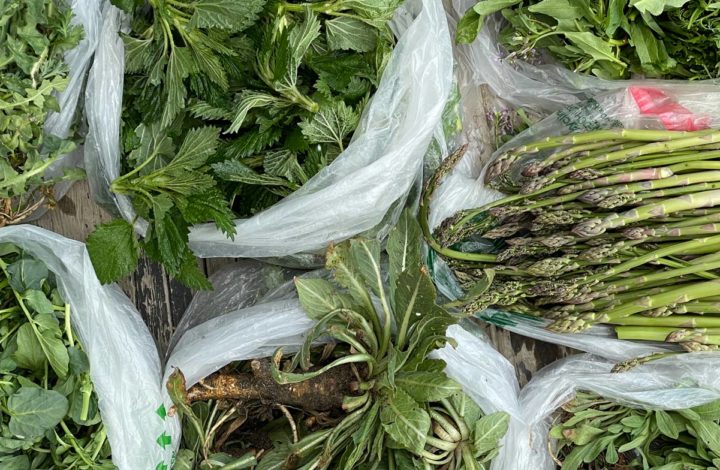
That’s right: It’s November, and foraging season down Denver way is still kicking. Below is what I came home with yesterday. It’s stuff you might be able to spot, right now—and, upon absolute positive identification (of course), get busy with in the kitchen yourself:

Read the rest of this entry

Pennycress Honey Mustard recipe at long last

pennycress honey mustard venison 350x333 Pennycress Honey Mustard recipe at long last

Wild pennycress honey mustard on crackers with venison summer sausage.

I’ve done it, Igor! I’ve created a recipe to deal with that monster who’s been pounding down my door for one. Namely, my mom. My mom is a pennycress honey mustard-seeking monster.

My idea for pennycress honey mustard was born first of an attempt to make normal pennycress mustard—if there is such a thing—which comes out tasting okay but not altogether great, I opine. Pennycress has a strong, some say garlicky— though I say distinctly pennycress—flavor. It was the addition of honey, however, that sealed the deal between me and pennycress forever.

I love gathering the pennycress seeds—first spotting the dry, light tan stalks and seedpods that mean it’s ripe for  harvest, then stripping the seeds and chaff into a collecting container. Afterwards walking while directing short, strong puffs of breath into the container, blowing chaff from seeds, albeit into my nostrils and eyelashes. No matter, for a precious prize remains at the bottom, like colors separated from black sands at the bottom of a gold pan—pennycress seeds! Read the rest of this entry

 Page 3 of 13 « 1  2  3  4  5 » ...  Last »