
I recently traveled to Vietnam, where I made it my mission to find edible wild plants in three places—the wild, the markets, and the cuisine. I was struck by how important wild foods are to the Vietnamese people; they use them much more and as a regular part of their food culture than we do here in the United States. People transplant wild plants to their homes and cultivate them for regular use. Here’s a roundup of some of my favorite finds. If you visit Southeast Asia, I hope you’ll have as much fun as I did chasing these plants:


Pepper elder
I tried càng cua early in my trip, in a salad served at a buffet—but I didn’t find it growing in the wild until much later. Also known as pepper elder, Peperomia pellucida (above) is a small, fleshy herb with translucent stems and heart-shaped leaves. It reminded me of chickweed, but it’s in the Pepper family. I finally spotted it in Saigon, growing as a weed in planters and disturbed places. Later, I saw it all over the place in southern Vietnam. This edible wild plant is also native to Texas, Louisiana, Georgia, and Florida.


Wild betel leaf
Often translated as “wild betel leaf,” lá lốt (Piper sarmentosum) is a slightly hot, aromatic wild leaf used in the popular grilled dish, “beef in leaf.” This plant is also in the Pepper family, along with black pepper. Vietnamese people transplant it to their backyards from wild cuttings. The English translation says “betel leaf.” It’s not the same betel leaf chewed with areca nut (the stimulant), but it’s a close relative.
Ming aralia
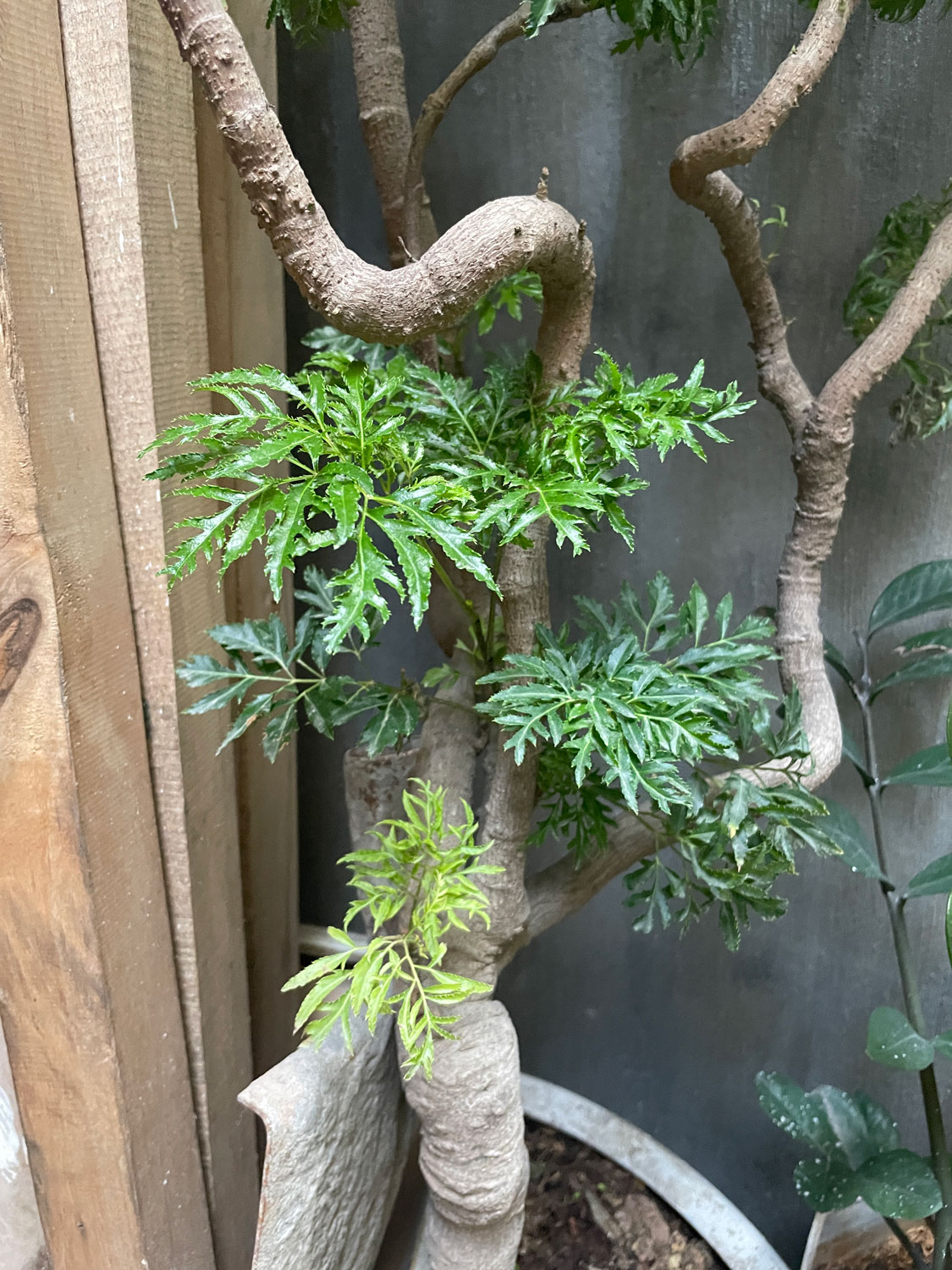
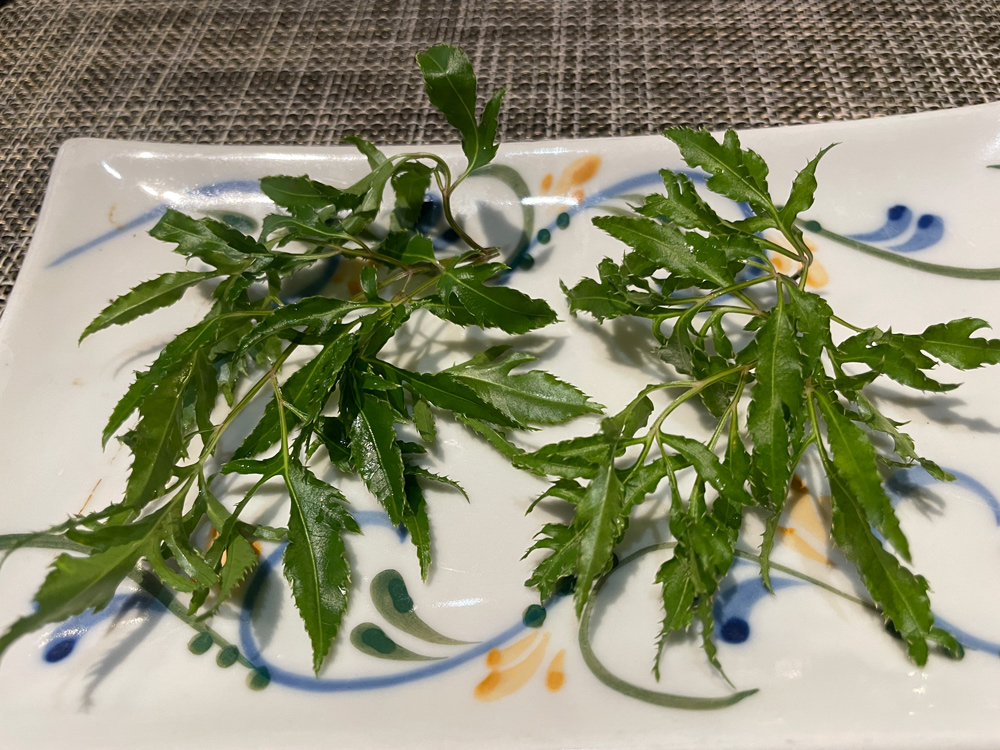
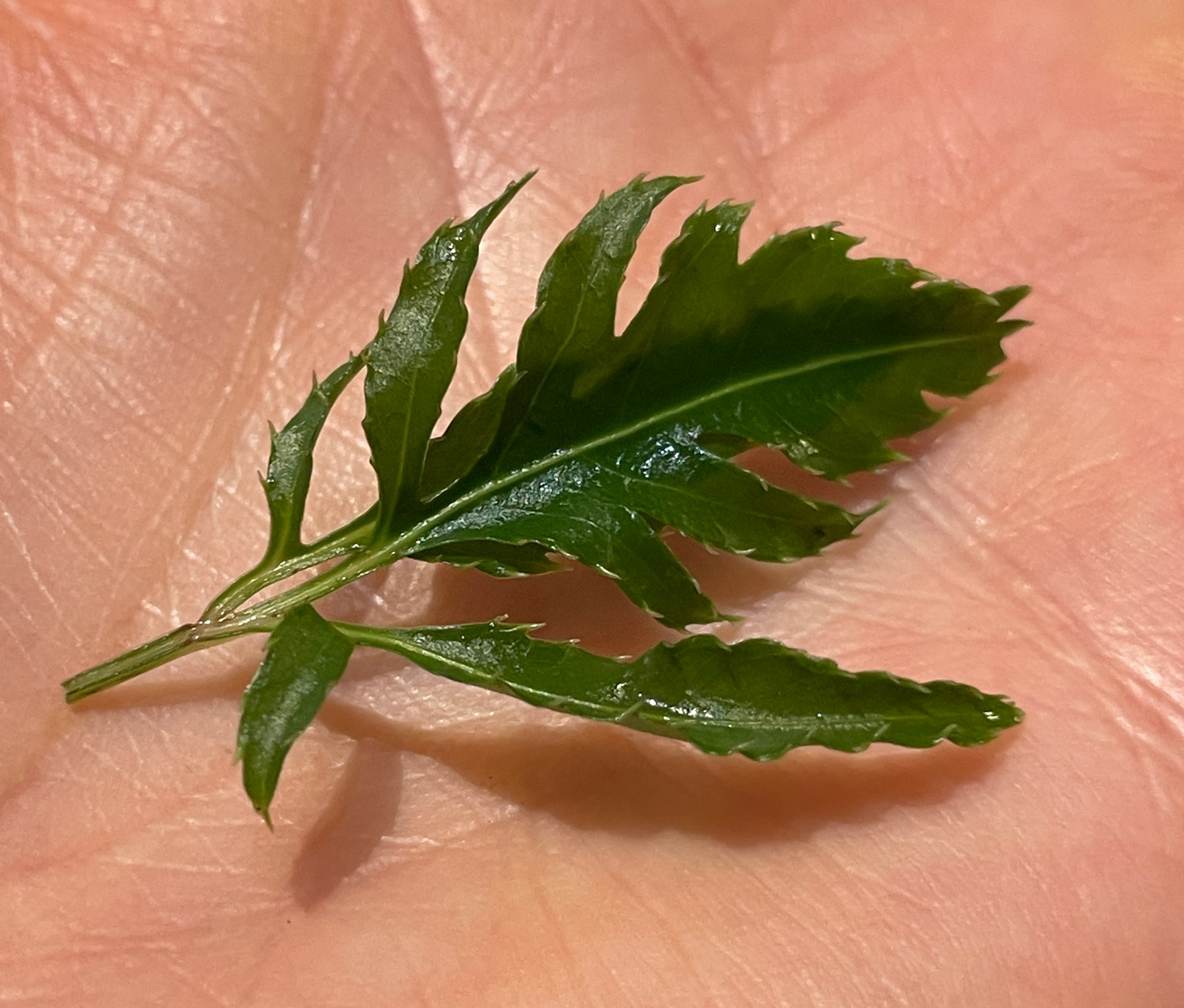
This aromatic leaf garnished a plate of food served to me in Hanoi. Known as đinh lăng in Vietnamese or ming aralia in English, Polyscias fruticosa is a wild plant now widely cultivated throughout the country for food, medicine, and bonsai. Turns out, it’s a favorite houseplant in the United States too. It’s a relative of ginseng, in the family Araliaceae. Maybe you have some at home you can sample.


Pennywort
Pennywort (Centella asiatica) captivated me from the start. On our first outing to a weedy place—okay, we were actually touring city farms on a motorbike, but I was always chasing weeds—I saw it growing in abundance. What a great weed, I thought. I wonder if it’s edible. Sure enough, this common Carrot family plant, also known as rau má in Vietnam or gotu kola in India, is widely used both raw and cooked. In Saigon I tried it in a popular drink of blended pennywort and water, served with ice. It’s the closest I came to a green smoothie on the whole trip; it was a delightfully fresh and healthy drink after a hot day in the city.


Water spinach
I saw water spinach (Ipomoea aquatica) in nearly every market. In Vietnam it’s called rau muống—sometimes translated as “morning glory” because it is in the Morning Glory family. It’s in the same genus as sweet potatoes, not to mention a few inedible morning glories that have psychoactive alkaloids in their seeds. Water spinach grows wild in irrigation ditches, stream sides, and fields, but it is also widely cultivated. I loved in a bowl of pho noodles. Often, it’s served stir-fried with garlic. It has such a fresh, green flavor, I could eat it every day!


Lotus
There is no end to my love for lotus (sen). In the States we have a wild American lotus (Nelumbo lutea) you can harvest for its various edible parts, although I have yet to try this. In Vietnam the species is Nelumbo nucifera. It is the national flower, and in Buddhist tradition represents purity, enlightenment, and rebirth. People eat the stems, rhizomes, and tubers, but I mostly sampled the sweet, starchy seeds—in soup, fried rice, and even a sweet iced drink. In the market I found them in the form of crunchy snack nuts; according to the vendor the process was to boil, dry, and roast them. OMG I could not get enough! I have one last pack to play with—dried seeds I plan to long-boil for hot cereal—which I bought at a convenience store. It is very labor intensive to remove lotus seeds from their seedpods and shells. All the more reason to consider them infinitely special!


Vietnamese spinach
In many of the open-air markets I found “Vietnamese spinach” (Basella alba), also known as mồng tơi—although you might be more familiar with the names Malabar or Ceylon spinach. It is not related to spinach, but the leaves have that thick, spinach-like texture. Instead, it’s a tropical vine that grows wild in disturbed areas. It is also widely cultivated. I kept seeing it in the markets but finally got a chance to try it in a bowl of soup, where I appreciated the texture and mild flavor. A friend told me she has Malabar spinach in her Colorado garden, where it grows well. So, that’s on my seed list for next year.

Mekong River Delta flowers
I’ve been obsessed with edible “Pea tree” flowers for a long time—meaning Pea family trees and shrubs that produce edible flowers. Gardeners are sure to recognize their distinctive form—each flower has a 2-petal banner in the back, 2 wings on the sides, and 2 fused petals that form a boat-like keel in the front. At home I adore the pink flowers of New Mexico locust, and the white blossoms of black locust. Lesser known are the edible yellow blooms of Siberian pea tree, although they’re not as good. Anyway, it was a treat to meet another edible Pea family tree flower in Vietnam—Sesbania javanica, known locally as điên điển or Mekong River Delta flower. They grow along the rivers, although I didn’t get to see them in the wild. I liked the salad though!


Fish mint
This plant really tripped me up. We were eating at a local restaurant, building our own spring rolls with greens and fish (or in my case, tofu). I stuffed my roll, bit into it, and nearly gagged on a flavor I can only describe as tasting like old fish. I suspected various foods—maybe the tofu was fried in old oil, maybe the dipping sauce had something weird in it? Alas, it was the leaf! Houttuynia cordata is called fish mint (diếp cá) for a reason! People forage and cultivate this green; it’s especially popular in southern Vietnam, and my guide was a big fan. I very much want to like every wild green I try, so I sampled it a few more times—but I just cannot stomach it. Are you excited yet? Because you can find fish mint growing as an invasive species in many parts of the eastern U.S. One person even told me she has it as a garden escape in Colorado. So go on, eat it, and tell us what you think!
This wild food adventure wouldn’t have been the same without our guide, Phong, who patiently answered my endless plant questions and shared his love for Vietnam’s wild foods. In addition to his expertise, I relied on the book, Edible Plants of Vietnam: The Bountiful Garden (2007) by Yoshitaka Tanaka and Nguyen Van Ke to help me sleuth out and understand these vegetables.
So interesting to read about! And having followed to some extent on FB I know you didn’t include all the plants you found.
The Mekong Delta flower reminded me that here in the east we have redbud (Cercis canadensis), a native tree, with edible flowers and young leaves.
Hi Iris, thanks for the reminder about redbud! Yeah, on FB/Insta I also posted about a lot of tropical fruits that are not necessarily wild, just another obsession I have… but certainly folks wanting to read all the Vietnam posts should check out Instagram @wild.food.girl or Facebook @wildfoodgirl. Thanks!
Did you find galangal?
You go girl , Many more wild places and plants to explore. every part of our world has provided . Remember grocery stores are new . wild foods are as old as human kind. Keep us posted with your adventures. And thank you for your posting . your one of my favorites for years now.
You know, it wasn’t even on my radar. It is now! Cheers
Interesting that pennywort is the same as gotu kola! I know that as a popular herbal supplement that’s used for a wide range of things.
We live in rural SW Minnesota and there is a large Hmong population here (MN has the largest Hmong population in the US, mostly Vietnamese refugees who we secretly recruited to help us during the war and then faced persecution and imprisonment afterwards). When we are out foraging, we often run into Hmong families foraging too, and it’s always interesting that they are looking for such different plants than we are. We’ve tried chatting with them before and we show each other what we’re looking for, but the language barrier can be a problem since it’s generally the older ladies we encounter and they are less likely to speak English.
I’m also curious if you’ve ever tried Asiatic dayflowers (Commelina communis or Ya Zhi Cao) either fresh or cooked? They are invasive and very common in the US (and resistant to glyphosate, so farmers hate them), and they are all over a part of my yard. I keep them because of the amazing blue paint you can make from the flowers, but I know they are supposedly edible. I haven’t tried them yet but I hope to soon.
Hi Alicia,
I’m sorry I missed your comment earlier. I have not yet tried Asiatic dayflower, but I’m looking forward to doing so. How interesting and cool to run into Hmong folks foraging, and especially the fact that they are looking for different plants! The pennywort in my Vietnam post is Centella asiatica, which is only reported in the U.S. in some Southern states. There are other plants called “pennywort” in the genus Hydrocotyle that are found in Minnesota, but I don’t think those are the same as gotu kola. Do you eat your local pennywort?
Sincerely,
Erica