Pine Nut Dessert Extravaganza

pine nut dulce leche cookies 450x337 Pine Nut Dessert Extravaganza

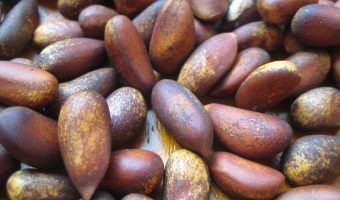
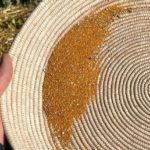
Sugar cookies topped with homemade dulce de leche caramel and wild foraged pine nuts. Note the color variations in the seeds. Also note my one attempt at making a pine nut covered candy. It turned out flimsy.

Everything I’ve ever read says that pinyon nuts (Pinus edulis) are ready for harvest in late summer and fall. So you can imagine my surprise a couple weeks ago, while passing through Utah’s Great Basin on our recent road trip, to find fallen pine nuts with the nutseeds intact, ripe and ready to eat.

Throughout the trip I’d been absentmindedly pinching fallen pinyon nuts whenever I saw them, but always getting air. Then one day during a bathroom stop I got out of the car and looked up to see the most cone-laden pinyon tree I’d ever seen. All of the cones were dangling open, so I looked down to see a litter of pine nuts in the duff underneath. I picked one up and pinched it only to find a firm, white-tan seed inside! Incredulous, I popped it in my mouth, and was further astounded by the flavor.

When Gregg got out of the bathroom I asked him to climb under the tree with me to collect pine nuts. (In case you’re wondering, these are the same pine nuts that can be purchased in the grocery store—except that usually the pine nuts you buy at the store are imported from overseas, despite the fact that pinyon trees grow wild in large swaths across the western United States and Mexico.) Read the rest of this entry

Whitetop—A Wild Invasive Substitute for Broccoli

whitetop Fort Collins 450x337 Whitetop—A Wild Invasive Substitute for Broccoli

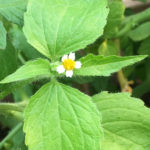
Whitetop is a listed invasive species, targeted for eradication in areas of Colorado and other regions.

I’ve been meaning to try eating whitetop, aka hoary cress (Lepidium draba, syn. Cardaria draba)—an invasive plant targeted for eradication in parts of the Colorado high country and undoubtedly other locations too. It saddens me to see whitetop taking over entire fields; I always wonder what plants might grow there if that whorey mustard hadn’t so asserted itself.

Last summer, when Colorado wild edible plants expert Cattail Bob Seebeck gave me my first taste of whitetop flowers in a farm field in Mesa, it nearly burned my tongue off—a seriously spicy mustard. Which is why I was so surprised that my friend Butter found it to be pleasant and mild prepared in the style of broccoli rabe. She harvested the tops before the flowers opened, including a small portion of stem and leaves, then blanched and sautéed the hoary cress with salt, red pepper flakes, and red wine vinegar. Read the rest of this entry

Frisco plant survey 0591 450x337 Wild Edibles at Meadow Creek Trail in Frisco—Photo Gallery

Hello you sexy cow parsnip, you! (Heracleum maximum) Frisco, 5.20.13

It’s been funny weather up here in the high country lately. Where we live at 10,000 feet, it has been snowing fat, clumpy, wet flakes for days. Then yesterday, late morning, I headed to Frisco through pouring rain to survey some trails.

At my first stop, it was snowing and blowing and cold, so I donned my coat and hat before poking around. There were big snow patches across the trail and not too much in the way of edible spring growth. But then at the second and third stops—both uphill hikes through trees—it was warm enough that I had to shed both, and the sun peeked out, sending rays of dappled light to illuminate the freshly sprinkled plants.

I found spring—and the best diversity of edible, wild, high country plants—at Meadow Creek Trail #33 in Frisco, accessed from the I-70/Highway 9 traffic circle. It’s a somewhat strenuous uphill hike that takes you through an aspen grove to Lilly Pad Lake if you go far enough. I’d almost skipped it, not relishing the idea of hiking up, up, up, but then made a last minute decision to stop anyway. I was happily surprised to find so many of my wild edible friends had sprouted—some “wild” in the sense of native plants that belong to the forest, and others introduced species gone wild but growing in such a healthy state that they looked good enough to eat. Read the rest of this entry

Baked Curly Dock Chips a la Kale Chips

curly dock chips1 450x337 Baked Curly Dock Chips a la Kale Chips

Curly dock chips on the docket for snack time. The was my first batch, when I went through the effort to remove the midribs from the leaves.

Who needs kale chips when you can have dock chips? For this project—a bastardization of two online recipes for kale chips (Food Network, Allrecipes), I used young curly dock leaves (Rumex crispus) foraged a couple days ago in the outskirts of Fort Collins, Colorado. With the recent rains the dock is looking good, especially if you catch the young, light green leaves shortly after they unfurl, before the bugs have a chance to get to them.

Unlike kale, which is a mustard, dock is in the Polygonaceae family, which includes buckwheat and rhubarb—so the chips are bound to taste different than kale chips to some palates. To my simple one, both give the sensation of a melt-in-your-mouth crisped vegetable, which I find appealing.

One of the kale chips recipes I followed said to cut the leaves from the leaf stems, and to then rip the leaves into pieces. For my first trial I removed them from the midribs but didn’t rip the strips into smaller pieces, which made it easier to flip once they were in the oven. I tossed the leaves in oil and spruce salt and laid them out, not touching each other, on a cookie sheet, baking for probably six minutes at 275 degrees before flipping them over, one by one, using a spatula and my fingers. Read the rest of this entry

Black Greasewood with Tofu Cubes

tofu black greasewood 350x262 Black Greasewood with Tofu Cubes

Pan-fried tofu cubes with black greasewood leaves.

Last night I all but destroyed the kitchen, scurrying about cooking up a wild feast like a person possessed. It felt good to be back home experimenting with wild ingredients again after our recent road trip to parts west, to channel all that inspiration from finding exciting new plants into food while my better half lounged on the couch. And, of course, it was snowing while I did so, here in the last stronghold against spring at 10,000 feet in the Colorado Rockies.

One of the dishes I made uses the leaves of black greasewood (Sarcobatus vermiculatus). The sprigs of the desert shrub had been sitting in the refrigerator for the last week and a half or so since we gathered them from a Nevada alkali flat. Not because I’d forgotten about them—rather because I was leery of the odd new plant, and awaiting responses to my recent query in the Edible Wild Plants group on Facebook as to whether anyone had eaten it before. Fortunately Brad VanDyke, based in Utah, responded: “I have eaten it, and like it. However, it does contain oxalates, so be careful,” he wrote. As certain commercial veggies we consume—like spinach—contain oxalates too, I took that to mean: Don’t overeat. As in an entire pound in a sitting. Read the rest of this entry

Wild Edible Notebook—May release!

WEN cover 640 224x350 Wild Edible Notebook—May release!

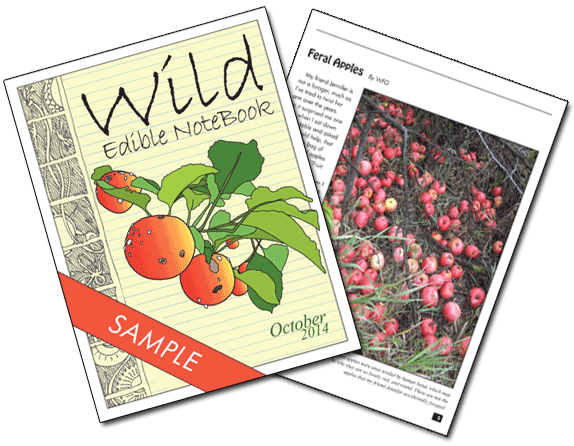
The May flowers have arrived, and with them, another edition of the Wild Edible Notebook! This issue includes a spring foraging report for California’s Eastern Sierra based on a recent foray Gregg and I undertook in the Mammoth Lakes region, though most of the plants featured have a much broader distribution. It includes a reprint of an earlier blog piece on wild asparagus, plus new photos and informative tidbits. There is also a review of Langdon Cook’s Fat of the Land: Adventures of a 21st Century Forager. (The book was published in 2009 but it’s worth a read if you haven’t done so already, especially now that Cook is on the verge of releasing a new book.) As always, a handful of wild recipes conclude the Notebook.  

As with all other Wild Edible Notebooks, if you want to read it, you have to download it—and that means joining the list if you haven’t already.

How to Join the List

If you go through the process to join the list you will receive one (at most two) emails from me a month. You can unsubscribe whenever you want. To join, scroll to the very very bottom of this page and fill in your info. You’ll receive an email asking you to click on a confirmation link, and after doing that, you’ll get another email with the download link for the latest issue of the Wild Edible Notebook—in your choice of either a handy print-and-fold booklet or a file you can breeze through onscreen or print out one-sided. You’ll be able to access a few prior notebooks as well. Read the rest of this entry

Ready-made Road Trip Salad

road trip salad 350x258 Ready made Road Trip Salad

Ready-made road trip salad–my favorite of all the road meals on our inaugural trip with Myrtle the van.

We embarked on a road trip through Colorado, Utah, and Nevada to California’s Eastern Sierra last week. I had a lot of delicious wild greens on hand that I’d collected in Denver immediately prior, and I wanted to eat fresh salad for the duration of our journey through the deserts, so this is what I came up with.

The cabbage was a lazy last minute choice as a base to temper the bitter and pungent wild greens, as we had no store-bought lettuce in the house and I didn’t feel like going out to buy some. I packaged it all up in a big bag, and the dressing in a recycled salad dressing bottle, and served it nearly every day of the trip.

Surprisingly Gregg—who is not much of a salad eater—asked for it every time, and touted my culinary prowess. Score! Read the rest of this entry

Let Us Appreciate Wild Lettuce

prickly lettuce rosette 270x350 Let Us Appreciate Wild Lettuce

This prickly lettuce rosette is not too happy, but you can get a sense of the color and form from the photo.

One of the things I like about gathering and eating wild plants is how it evokes time travel. For example, eating prickly lettuce (Lactuca serriola)—commonly believed to be the ancestor of modern, cultivated lettuce—is like taking a journey back in evolutionary time, back to before we bred so many of the good things out of the plants we eat.

Prickly lettuce is prickly, as the name suggests, with small bristles on the leaf margins and in a line along the underside of the leaf midvein. The leaves—both in the spring rosettes and the mature plants—suggest dandelions, as they start out with wavy margins that are not deeply lobed, and develop into leaves “with serrations, clefts and lobes,” as Cattail Bob Seebeck describes them in his 2012 textbook, Survival Plants of Colorado, Vol. 1.

One distinctive characteristic of prickly lettuce is that the mature plant turns its leaves sideways to point east and west, as Euell Gibbons relates in Stalking the Faraway Places (1973).

This is the plant’s way of maximizing exposure to sunlight, Sam Thayer writes in Nature’s Garden (2010); the result is a plant that looks as if it “has been pressed between two pieces of plywood.”

Prickly lettuce, like dandelions, exudes a milky sap, though I’ve had to cut the leaf veins and squeeze for a bit to find it in young specimens. Mature plants develop small, dandy-like yellow flowers. Read the rest of this entry

Denver Mustard Mania

musk mustard path 249x350 Denver Mustard Mania

A carpet of musk mustard along Cherry Creek Trail in Parker. Look, but don’t pick, at this spot.

I’m just back from a two-day spring foray in Denver, where I visited old places with old friends and new places with new friends, along with a few solo missions—looking for wild edible plants, of course.

How nice it is to see spring springing up down low (around 5,000 feet), to hear birds chirping and see people out walking, enjoying the sun. Swaths of green decorate expanses of earth where not long ago it was white with snow or brown and dry.

Among the plants I observed and collected on this trip, wild mustards made a strong showing. These are often overlooked or passed over for sexier wild fare, but wild mustards are plentiful and accessible throughout Denver area right now—making them a good choice for a late April, early May foray.

About Mustards

Mustards are in the Brassicaceae family, which includes both wild and cultivated plants. Brassicaceae family members you can buy at the grocery store include such ubiquitous veggies as broccoli, cabbage, cauliflower, turnip, radish, horseradish, collard greens, and kale.

Brassicaceae family members you can gather for free in the Denver area right now include musk mustard (Chorispora tenella), tansy mustard (Descurainia sophia), field pennycress (Thlaspi arvense), and watercress (Rorippa nasturtium-aquaticum) if you’re brave. Other wild mustards in the U.S. and beyond include field mustard (Brassica rapa), wintercress (Barbarea vulgaris), garlic mustard (Alliaria petiolata), and shepherd’s purse (Capsella bursa-pastoris), all of which are covered in the “pungent greens” section of John Kallas’ (2010) book, Edible Wild Plants. Read the rest of this entry

Chicken and Nettle Gnocchi Soup—Reflection & Recipe

nettle gnocchi chicken soup 350x284 Chicken and Nettle Gnocchi Soup—Reflection & Recipe

Chicken soup flavored with stinging nettle spice and accented with stinging nettle gnocchi dumplings.

This always happens to me. I come into some wild food and then I get a wild hair to make something genius with it in the kitchen. So I dedicate myself with so much time and energy that I overextend myself, producing mediocre results. Then since I’ve committed so much heart to it, I can’t stand to let the meal go unhonored or the story untold, so I produce such entries as Suillus Sludge Soup, and Everything Gnocchi without Moderation. The latter, from two days ago, recounts my fit of inexperienced potato gnocchi-making with a $1 markdown bag of potatoes that I swore I’d find a use for. Clearly I was overstimulated, unreasonable. And then of course afterward I’m drained, and less than satisfied with the results—so much work for what seems like so little gained.

I always forget to realize that the true prize comes later. A moment of genius strikes, a reward after so much hard work. If you honor it, and go with it, often some minute genius will result—like this recipe for chicken and nettle gnocchi soup. It’s really just a dumb little soup I threw together haphazardly while doing laundry and dishes and cleaning the house. I was making a chicken-carcass-rescue soup, and decided to throw in some of those pretty, green, dried nettle flakes leftover from the other night, as well as the nettle gnocchis. Read the rest of this entry

 Page 1 of 13  1  2  3  4  5 » ...  Last »