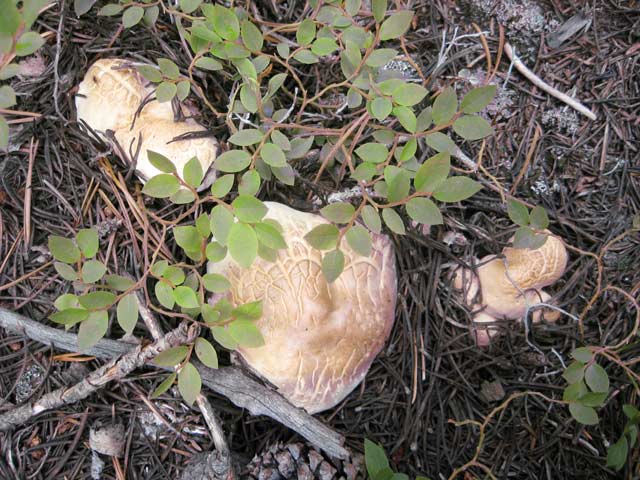
There’s a funny mushroom growing all over the conifer forest behind our house at 11,000 feet above Fairplay, Colorado. It is light pink/peach in color, similar to a white person’s flesh, but cracked on the surface, like an overworked foot. As this mushroom ages, a green mold takes hold amidst the cracks and on the surface and the mushroom itself gets firm and tough.
Does this sound appetizing? Because we’ve been really excited about eating this mushroom lately.
An Albatrellus a Day
The mushroom is Albatrellus confluens. Vera Stucky Evenson describes it in similar terms to mine but without the human body part analogies in Mushrooms of Colorado and the Southern Rocky Mountains (1997). A former name for the same mushroom is Polyporus confluens, according to Michael Kuo (2007) at mushroomexpert.com.
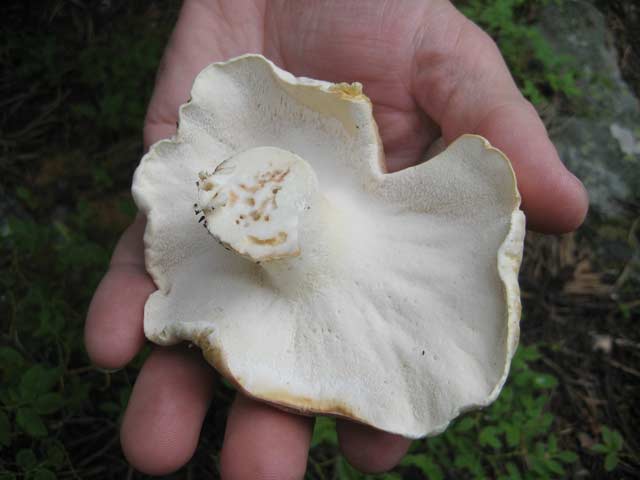
It is a polypore, family Polyporaceae—which means “having many pores” as opposed to gills. The porous undersides of our guys’ amorphous caps are white and contain, as Evenson describes, “tubes with tiny, white, rounded pores descending thick stalks” that looks like a thin white sponge. They grow “in confluent masses” meaning many altogether; we find them in clumps. Furthermore, Evenson says the “weathered caps are often tinged with a green, moldy surface growth.”
We saw these guys all the time last fall during the dawn of my interest in mushrooms, but did not know they were edible until Gregg gave me Evenson’s book for my birthday.
Albatrellus confluens is found specifically at high elevation under conifers, according to coloradomushrooms.com. The mushrooms are purported to smell “sweet and fruity,” but to my undistinguished sniffer they smell mushroomy and good, like some kind of mushroom I’d consider eating, excessive green mold and worms notwithstanding.
Soft Flesh is Food for Many
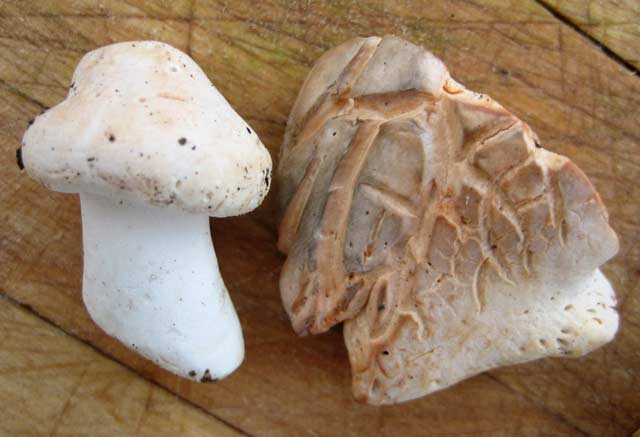
For my first trial, then, I aimed for the young, soft mushrooms. Unfortunately, the worms seemed bent upon doing the same. It had been dry for a while at this point, and each time I cut a few small, young mushrooms from their clusters at the base with a knife, I flipped them over only to discover tiny translucent worms wiggling out of the many holes in the stalk. The worms seem to start in the stalk and move out to the cap, though I have seen decay holes in caps with clean stalks too. Luckily, there were a few whose caps remained relatively unaffected.
It’s hard to tell if a mushroom is going to be wormy before cutting it. At first I tried inspecting each one on my hands and knees, making an effort to judge the extent of the worm invasion by the number of tiny holes in the cap. My technique evolved over the past week to making a thin slice at the outer edge to see how far the worms had colonized a given mushroom before deciding whether or not to take the whole thing or just to drop the cut cap piece into my bag.
That first day I refrigerated my Albatrellus finds and waited for Gregg to join me on mission #2. He had better luck than I, nabbing three small mushrooms with narry a worm hole to be found as we perused the forested property behind our house.
Back in the kitchen I processed both batches, throwing away numerous worm-affected chunks but getting about ¼ cup of clean cap and stalk pieces for our first culinary trial.
Yet to Find the Foul in Albatrellus
By all accounts, Albatrellus confluens is supposed to be an inferior mushroom. Evenson says it is latently bitter, and Michael Kuo says it tastes “mild or cabbage-like and slightly foul.” Slightly foul? That did not sound promising.
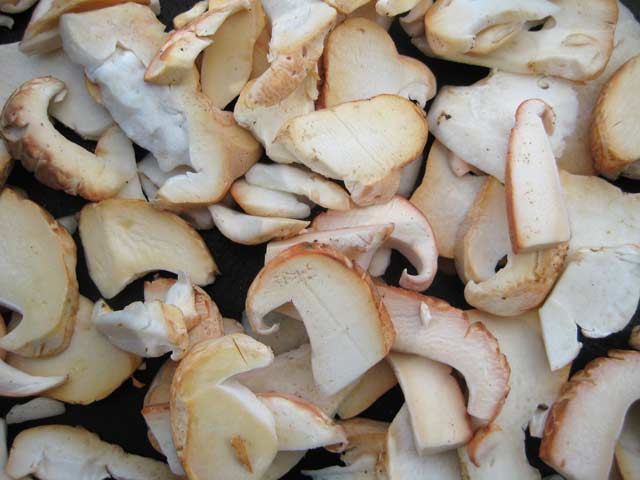
We sliced the salvaged parts thin, sautéed them in butter—and found them to be surprisingly good!
On August 1 we gathered more, including one that was almost the size of my hand and looked fresh but turned out to be wormy in the stalk and discolored with miniscule worm holes throughout. We were hoping to find an older one so we could test the “bitter” principle—but the older ones were wormy and the pieces we did manage to salvage on the second go-round were yummy too.
What are we doing wrong?
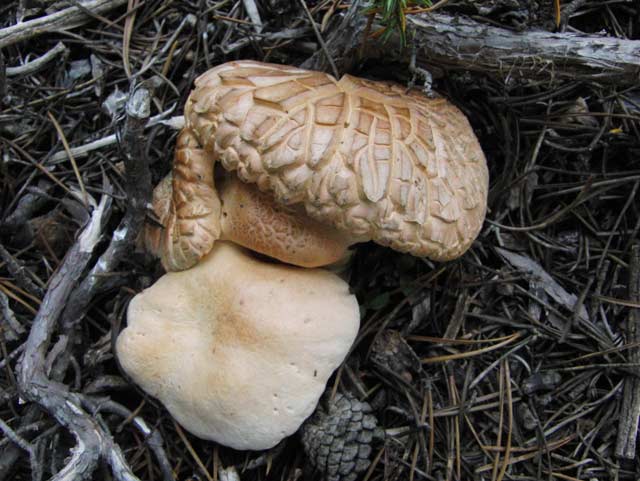
Yesterday afternoon we gathered a third batch of A confluens. They seemed to enjoy the heavy rain of the night before, as they were up in bigger, more amorphous clumps. Right after the rain but before colonization occurs seems like the best time to get them, as most of this batch was worm-free. Gregg discovered that the less cracked the mushroom’s surface, the younger and possibly less wormified it would be, so he aimed for the smoothest ones he could find and that seemed to work well. We probably got a whole cup of mushrooms when all was sliced and done.
I sautéed that last batch with onions and the result was so good that, after dinner and two wild edible gin and tonics later we went on a slightly intoxicated mission into the fading light to gather more A. confluens before the worms could get at them.
Mushroom Superstitions

My friend Butterpoweredbike believes that if you voice the word “mushroom” while hunting them, the edible fungus will hide and you won’t find any. On the other hand, Gregg and I like to creep through the woods calling to them softly: “Mushrooms, mushrooms, where are you?”
After stumbling upon some newly fruiting big brown gilled brown mushrooms last night, Gregg began to preach about his technique. “You can’t look for them; you just have to let them attract you to where they are,” he lectured. “You have to have a very loose hold on your decision-making.” I see. But last night’s dusk mushroom mission was a successful one, so who knows—perhaps it was due to the “loose hold” on decision-making that the gin had rendered unto me.
We foraged another good batch of Albatrellus, and in the process spied not one but two big lumbering porcupines, each of which Gregg found necessary to chase through the woods like a little kid. And I stumbled upon a half-melted bolete—a Leccinum fibrillosum, we think, the Leccinum that is associated with conifers and not with random poisonings, as the aspen-associated Leccinums have become.
So it’s mushroom season up here, finally—a happy realization that is further bolstered by last night’s second round of strong rain.
Mushroom Monikers
I’d been kicking around nickname ideas for A. confluens, as I have been unable thus far to find a common name for the mushroom.
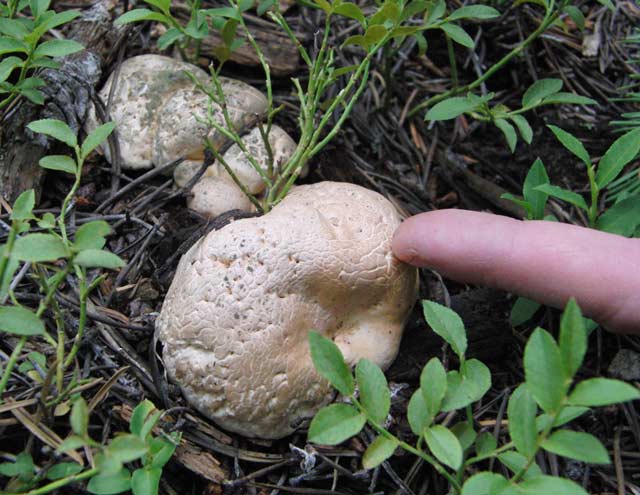
I wanted to call them “brain mushrooms” on account of their color and amorphous, cracked appearance, but apparently the poisonous false morel Gyromitra esculenta already has that nickname, looking much more like a brain than Albatrellus with its copious folds of flesh, so I’m going to need another one. I thought of “cracked pink peach mushroom” and “cracked human flesh mushroom,” but Gregg thinks they look more orange than pink and furthermore refuses to eat any if I refer to them as “human flesh.”
Michael Kuo at mushroomexpert.com describes A. confluens as having “a beautiful pale orange cap, a creamy pore surface with tiny pores, a sturdy stem, and a white spore print.” Beautiful, eh? Maybe I’d just been looking at them wrong.
Yesterday as we crept joyfully through the forest, the name “pinkies” occurred to me, and Gregg appeared momentarily satisfied. Later in the day, however, he decided that no, we would call them Albatrellus and leave it at that.
The name evokes “albatross” for me, like I’m eating the pink flesh of the seabird—though I guess that works in place of “flesh mushroom” anyway. One way or another, I would be remiss to spend my days fighting the boyfriend over mushroom monikers of my own invention when they in fact have their own name already.
A ha! That’s what that is! I’ve seen those where we used to mushroom hunt a few hours south of you, usually when we’re gathering boletes (edulis and barrowsii). Our nearest mountain range is now much further south and we’re still exploring, trying to get a feel for the seasons, climate, and geography here. I’m so happy to have found your blog and I look forward to learning a ton.
You know, I have never found the barrowsii but do want to. South, you say? Thanks for the kind words!
Here are some excerpts of a Facebook conversation between myself, blogger Butterpowerebike from http://www.hungerandthirstforlife.blogspot.com, and self-described “retired psychologist” and “active mycologist” Arleen Bessette, who lives in coastal Georgia, regarding Albatrellus:
Arleen Bessette: Read your Albatrellus notes. Might have been A. ovinus and not confluens….
Wild Food Girl: Oh? What makes you say so? In Mushrooms of Colorado, Vera Evenson describes A. confluens as “pinkish tan to apricot colored,” as mine are, versus A. ovinus as “whitish cap with yellowish cracks,” which I’ve also seen but did not write about. Still, I’m open minded and am curious why you think mine might be A. ovinus instead of A. confluens.
Arleen Bessette: The 2 are very similar in appearance. A. ovinus typically has an aromatic and/or fruity aroma, and does not taste bitter and is a known edible. A. confluens usually tastes bitter, even after cooking. Both bruise or age with brownish-yellow-orange tones. And they are not synonomous… they have different reactions to KOH on the flesh. Just more interesting mysteries in the myco world!
Wild Food Girl: Ah, well, I will have to do the KOH test next season then…. wish I could do it this instant!
Butter Poweredbike I also use Vera Evanson’s as a guide, and have found a. confluens to be distinctly pinkish-orange, growing in masses, and very prone to a green mold. I take a small taste, and spit out, a piece of younger specimens in field to determine whether they are worth harvesting. Some are bitter, but the younger ones can be fine. The mushroom I’ve thought to be a. ovinus has a similar appearance in Colorado, but tends not to grow in masses, and has more of a white coloration, with yellow in the cracks. Overall similar appearance, but the coloration of the two strikes me as quite different. Curious to have another look at them next year, though… always open to the possibilities and mysteries.
Arleen Bessette: And I am certainly no expert on Colorado myco-critters like Albatrellus. Coincidentally, we found A. ovinus the other day here. Doing research, I ran across Michael K’s info on the golden yellow reaction on the flesh….bt you know, there are so many unanswered questions. There’s some possibility of varietal differences vs. differing species. Not a ‘shroom I see much of!
Wild Food Girl: This is a great conversation! Butter, thanks for chiming in. And Arleen, since I didn’t say it previously, it’s great to meet you via the internet! You might just have to come foraging up here some time. We have the prized Boletus edulis; it’s worth the trip… Anyway, mushroom season is long over at my elevation at 11,000 feet in the Rockies so I’m jealous of your A. ovinus!!!
Arleen Bessette And my pleasure to meet you, also! You never know…we just might meet up one day! Used to collect tons of B. edulis in upstate NY. Miss it down here. Cheers!
We’ve eaten Aspen Boletes, and never had any issues. We don’t eat the stems (we noticed they bruise a different color than the caps, so maybe chemically different), and we peel off the pore surface and only eat the caps. They dry really well, and other people around here do the same. No one reports any problems.
“Orange Albatross” works for me! I confess I always want to call them Albatrosses also, and that is one way to remember the name Albatrellus. Our mountains are fickle though, they only seem to give up the Albatrellus for our neighbors, and not for us.
Interesting enough, I found these Less than a quarter mile inland from the oregon coast in Lincoln, city on mossy ground clumped together in groups, hiding under a big fern! And NO cracked looking ones at all. They were next to a very old tree (not sure exactly what type of tree but lots of pine, hemlock ,huckleberry bushes and ferns around) so whoever said they grow specifically at 11,000 feet come down here to the oregon coast and see them for yourself 🙂 I wonder if butter bike brought the spores here all the way from Colorado on accident. Anyway I haven’t tried them yet but I looked at them on Wikipedia it says they produce grifolin, an anti cancer molecule so even if they taste bitter I might include them in my reishi tincture for medicinal purposes.
I have been eating A. confluense for years.
I have found that the terrible flavor arises from the green algae that grows on them. Avoid that, and they are delish!
As for worms, you will toss a lot of Shrooms if you’re picky. If you slice them and soak in water overnight in the fridge, the worms exit the flesh. They still taste great!
What a delight to see this conversation about Albatrellus. We live close to the San Juans, in SW Colorado, and this year we had a HUGE fruiting of Confluens. So stout, attractive and nicely aromatic mushrooms. Had almost no worm penetration. And after the rain stopped, the boletes withered away and the squirrels took everything else (except Cornucopia), there were still hundreds of Albatrellus. By then they were drier, and cracked on top like they’d been toasted, but still in great shape. Thank you for this edibility info.
Thank you, John. You know what I tried for the first time this year? Albatrellus ovinus, described in Colorado as fairly similar to A. confluens but with lemon-yellow undertones. I was expecting bitter but I had two batches on two separate occasions that were quite nice–nutty, and bright yellow after sauteing. I will be eating more!
Looks like they call this mushroom . Sure polypore in Russia etc . So I guess that is the common name. Just saw tons of them at my bolete spots . They smell good , I thought they might be Edible. I am going to grab some next time I’m out ! Thanks for the info !
In Norway we call the confluence for French bread-mushroom (fransk brødsopp) and the ovinus, we call sheep mushroom (fåresopp)
Ovinus is regarded as a delicacy and confluence is regarded as non-edible but not toxic. After this post, I will give the confluence a chance in the future.
Interesting! Please let me know what you think.