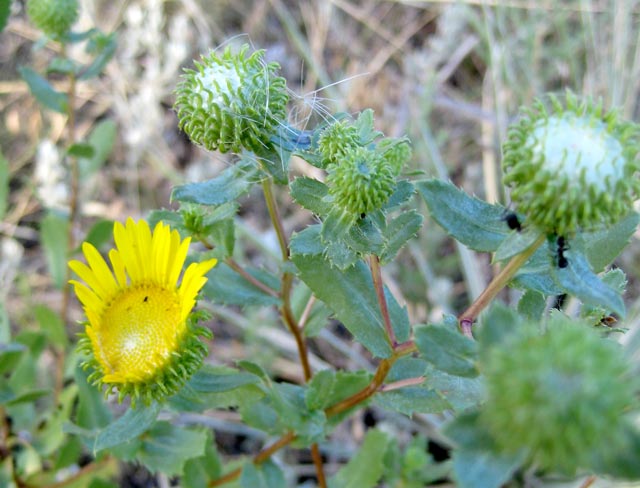
Sticky gumweed is so distinctive; it’s difficult not to notice when it’s blooming, which in the Colorado foothills ranges from late July through early September.
Also known as curly-cup gumweed or curly gumweed, both the “sticky” and the “gumweed” descriptors in these common names for Grindelia squarrosa refer to the gooey resin on the upper parts of the plant. The buds present as cups of the sticky white stuff, while the flowers sit atop “overlapping rows of backward-curling, sticky involucral bracts,” as Plants of the Rocky Mountains (Kershaw, et. al., 1998) describes them. It is in the resin that Grindelia’s medicinal properties reside.
Collecting Grindelia buds and flowers is a sure way to get covered with the stuff; fortunately, the resin has a delicious sweet smell to it. Wildcrafter Ryan Drum describes even previous years’ desiccating flowering gumweed stalks as having “a faint wonderful odor of vague incense.” He cautions against letting fresh buds and flowers heat up too much during the collection process, and recommends the use of well-ventilated paper bags for doing so.
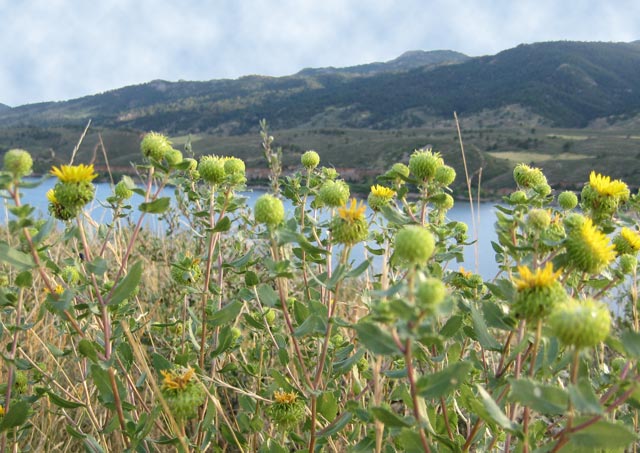
Long History of Medicinal Use
Sticky gumweed has been an important medicinal plant since pre-colonial times. Native people made extensive use of it (Drum, 2008) followed by European settlers. According to Plants of the Rocky Mountains, gum from the pounded flowerheads was applied to poison ivy inflammations and taken internally to relieve coughing and congestion. “Extracts from the dried flowerheads and leaves have sedative, antispasmodic and expectorant qualities…[and] are used in modern medications for treating asthma and bronchitis,” the book explains.
While some sources indicate that dried sticky gumweed can be used to make an effective expectorant, other authors assert that something medicinal is lost in the drying process and that fresh flowers and buds are the only way to go.
Making the Grindelia Tincture
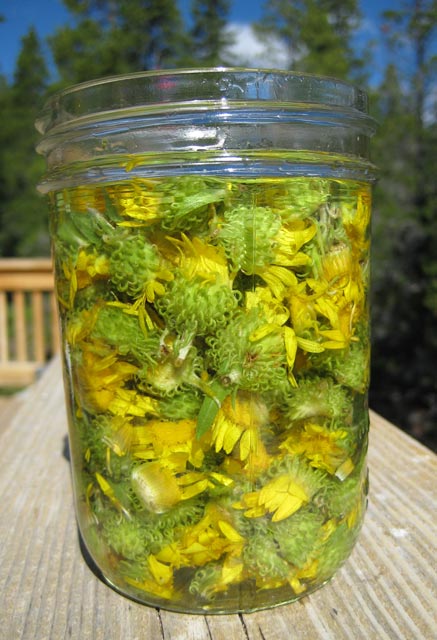
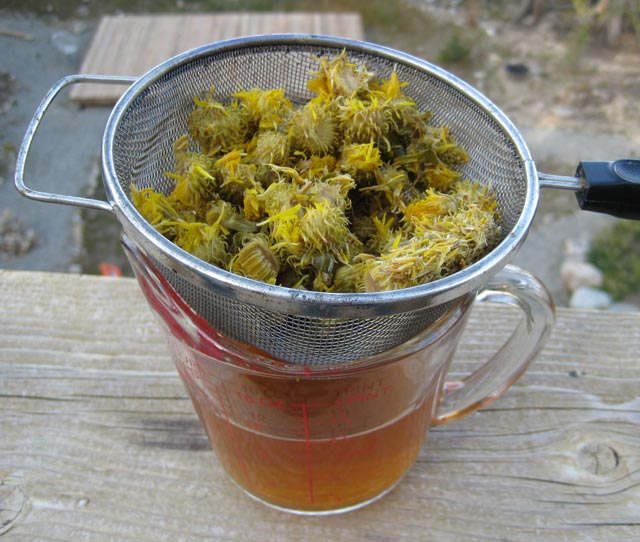
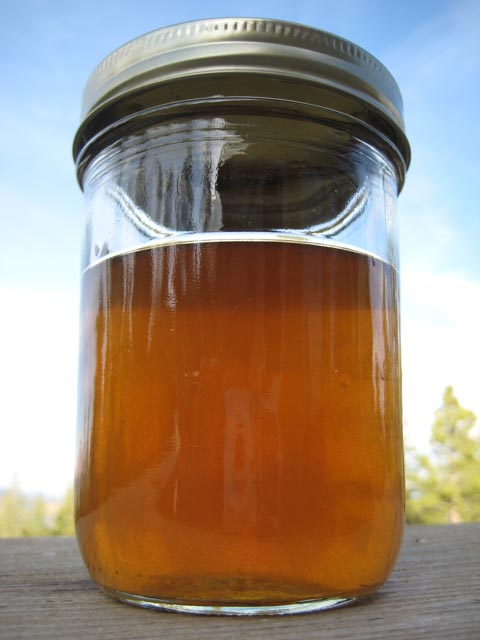
To make my own Grindelia tincture, I followed the instructions Claire Zimmerman (2009) puts forth in her article, “Sticky Gumweed, a Colorado Native Lung Healer,” in Edible Front Range magazine. This involves collecting sticky gumweed flowers (I later read on Drum’s website that the buds are even more jam-packed with goo), chopping them up, and placing them in a jar with enough alcohol to cover. Zimmerman recommends using a grain alcohol such as Everclear but says that vodka will work too, so I ended up stealing a few cups of vodka from Gregg’s mom for the purpose. Then it’s into a cool, dark place with the jar, taking it out for daily “jostlings” for a month before straining the flowers out of the liquid and either using immediately or storing (she says up to three years) for later use.
Zimmerman explains that the expectorant Grindelia is excellent for treating the lingering, dry cough that can last for months after a cold. “I think of Grindelia as the alternative to Osha,” she states. “Osha is most appropriate for a wet, boggy lung condition, while Grindelia will really get at that dry, unproductive cough, when a person is unable to cough up any phlegm.”
I made the tincture slightly more than a month ago out of flowers and buds I found near Fort Collins, Colorado, and there it sat in the closet, receiving none of the requisite jostlings. Out of sight, out of mind—until, that is, I did some intensive traveling (to Los Angeles, followed by Burning Man) and came home with a head cold followed by—you guessed it—a lingering dry cough. What luck! I hadn’t expected to be able to try my Grindelia tincture until winter!
One Cough that Refused to Linger
The one thing lacking from Zimmerman’s article is an indication as to dosage, so I guessed and treated myself with a spoonful in the morning and a spoonful in the evening, only to find out later from Ryan Drum’s website that I might have gone a bit overboard. You see, Drum uses 1 part buds to 3 parts aqueous alcohol (I think I used equal parts) in the tincture’s preparation and then “5 drops tincture under the tongue or in strong hot steeped yarrow tea” for treating coughs, colds, and flu. So, I may have overmedicated myself, but I will say this—the cough was gone in a week, and as an asthmatic I am particularly susceptible to lingering, dry coughs. Not that one experience proves much, but I am excited about my sticky gumweed tincture nonetheless!
In Deference to the Experts
I am also excited about Ryan Drum’s website, which I will continue to explore. Drum holds a BS in Chemical Technology and a PhD in Botany (Phycology) among a long list of credentials and experience with wild medicinal plants. “He lives in a rustic little hilltop cabin he built 30 years ago on a remote island, off the grid, without indoor plumbing or refrigeration,” states his bio. From his business, Island Herbs, one can order from a list [PDF] of approximately 60 different plants and plant parts, both fresh and dried. (I have not yet ordered any, but am intrigued). I’ll say this: the more I read, especially from experts like Dr. Drum, the more I realize that I’m flirting with things I do not well enough understand.
Regardless, I’m looking forward to having more dry coughs this winter so that I can experiment on myself further—and ultimately, on a good friend who suffers a chronic dry cough much of the year.
Non-Alcoholic Options
The only thing is that my friend who has the cough doesn’t drink alcohol, so I will need to find something else with which to create the tincture. According to Stony Mountain Botanicals, “for recovering alcoholics, liver problems, children or sensitivity to alcohol it is possible to make your tinctures using vegetable glycerin or raw vinegar,” however, “both glycerin and vinegar tinctures will be less potent and have shorter shelf lives.” Another option might be to make Grindelia oil or honeyed Grindelia buds instead of the tincture, using instructions from Dr. Drum.
Wild Drugs Save the Day?
Far be it from me to suggest that Grindelia, or any other plant, is some sort of magical cure-all that can rescue me or my friends from ailments for which we could not find adequate treatment previously. The fact is that I’m quite new to wild medicinal plants, but I suppose it is a natural progression from the wild edible plants obsession, and I like the idea of treating myself with natural remedies, free of charge. One way or another, Grindelia’s use to treat the one ailment that absolutely drives me crazy is exciting and I look forward to reporting on future successes with it here at Wild Food Girl.
UPDATE 7.22.11: Just realized I didn’t mention that when I made the medicine, I put the cover of the jar on it and let it sit for a month with the cover on. In case you needed to know…
We have a YARD (50 acres, certified Organic) FULL of Curly cup gumweed. Thanks to your posting, I have a pint brewing at the moment. Since I use Everclear (the higher the proof, the more constituents you can tincture out of the gummy buds.) What I did, since I’ll be watering it down, gathered buds (the more gum, the better) then poured Everclear over it. I shake daily when I remember (it’s on the counter), After a week, I gather more fresh buds in a clean jar, then poured the previous maceration over the new buds. Just this morning, I gathered another pint of buds and poured the previous alcohol over them.
I found drying them makes them look really unappetizing and rather green smelling. However, I did macerate a pint in Grapeseed oil to mix with mullein and comfrey leaf to make a salve later on. (too many irons in the fire currently)
In Arizona, a lot of we herbalists use grindelia for allergies – in combination with other herbs such as yerba santa, and also to dry up sinus colds, runny noses. I love this plant, and thank you for the article!
Hey! Thanks for a well of information, I found this article very useful as I get introduced to Grindelia squarrosa. I’m interested in preparing the tincture with fresh flowers (for a family of asthmatics), but where can I buy fresh flowers? I live in NYC, and from my understanding, the plant grows in dryer climates. Any information on a trusted source of fresh flowers, short of picking them myself, would be appreciated.
Many thanks,
Sanja
Hi Sanja, So sorry, I do not know of a source of fresh flowers. Best of luck!
Great info thank you.
To Sanja:
Go on to http://www.etsy.com and search ‘herbs’. Lots of people there sell herbs and some do wildcrafting. Send some emails; ask around. Worst case scenario, you may have to take a trip out of NYC to the local woods. Grindelia squarrosa grows in your state. ..here is the species distribution map:
http://newyork.plantatlas.usf.edu/Plant.aspx?id=6998
This is what you would forage for:
http://www.horsedvm.com/poisonous/gumweed/
Click on the photos to the left at above site.
Good hunting!
Hi Pntdldy,
We are a company that uses curly gum weed and we need more material. You said you have 50 acres of Organic land full of gum weed. Can you sell us some of your crop? If you are interested please let me know so we can plan ahead for next years crop and I’ll explain what we need.
Anyone else out there that has gum week to sell, please let me know.
Fresh flowers are NOT required to make medicine with this, or any, plant. When using fresh plant material I would use alcohol that is stronger than 100 proof. Even more so for a plant that has as many resins as gumweed. If using dried herb, 80 proof is just fine.
Just today my wife used Evening Primrose and Gumweed to relieve an attack of crappy perfume some people wore to church.
Thanks for the comment. Your school looks interesting. I started using Everclear myself a few years after this post. Cheers.
Edward Fletcher, I have access to a large amount of curly gum weed. My contact info is
I fond the plant I took some seeds up on the hills dry Sandy rocky ground
High resin plants respond well to vinegar tincture… Yes, it mayn’t be as strong as everclear, however, it is easier to use. Using as a vinegar, you can make your favorite tea, while hot- desolve raw honey, a dash of lemon and a teaspoon of curly cup vinegar…and you have a tasty, beneficial hot toddy! Drink a very small tea cup of this in the morning then refrigerate the rest. Take it with you to work or where ever and sip whenever your cough comes back during the day…have another cup at night… Fix a whole pint and drink cold… However you like… My aunt used this for COPD with great success… She kept a jar on hand and when the coughing attacks came on, she would sip it. with Stuff the jar, Include flowers leaves and stems… Cover with raw organic apple cider
Thanks for this info! I have never tried making a vinegar tincture but I like the idea as an alternative for folks who do not drink.
If you put your tincture in hot water to drink, as a tea, it burns out the alcohol. Totally drinkable for those who don’t want alcohol, and still delivers the herbal payload.
I have to tell you, your timing was perfect. My husband needed the tincture but didn’t want the taste of the alcohol, so I boiled it off. TY!
I know this is an old post, but anyone who needs gum weed is welcome to contact me at: . I live out west and other than it being a terrible product to harvest (only way to clean the tools is with rubbing alcohol) I have plenty, collected on my own property which is completely herb and fungi/insecticide free.
I have ACRES of this. I had no idea……. Looking forward to giving this a try. Thank you SO much for the information! Have a quart of the buds in everclear as I type .
Awesome! You are most welcome.
Does anybody know how to make this taste better? LOL. It’s nasty but maybe honey would make it better. Or maybe a honeyed tea. Thanks!