useful info Archives

Wild Edible Notebook—May release!

WEN cover 640 224x350 Wild Edible Notebook—May release!

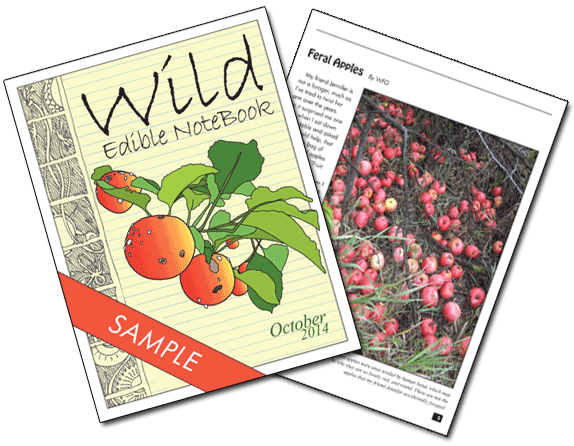
The May flowers have arrived, and with them, another edition of the Wild Edible Notebook! This issue includes a spring foraging report for California’s Eastern Sierra based on a recent foray Gregg and I undertook in the Mammoth Lakes region, though most of the plants featured have a much broader distribution. It includes a reprint of an earlier blog piece on wild asparagus, plus new photos and informative tidbits. There is also a review of Langdon Cook’s Fat of the Land: Adventures of a 21st Century Forager. (The book was published in 2009 but it’s worth a read if you haven’t done so already, especially now that Cook is on the verge of releasing a new book.) As always, a handful of wild recipes conclude the Notebook.  

As with all other Wild Edible Notebooks, if you want to read it, you have to download it—and that means joining the list if you haven’t already.

How to Join the List

If you go through the process to join the list you will receive one (at most two) emails from me a month. You can unsubscribe whenever you want. To join, scroll to the very very bottom of this page and fill in your info. You’ll receive an email asking you to click on a confirmation link, and after doing that, you’ll get another email with the download link for the latest issue of the Wild Edible Notebook—in your choice of either a handy print-and-fold booklet or a file you can breeze through onscreen or print out one-sided. You’ll be able to access a few prior notebooks as well.

NOTE: The comments about medicinal uses of plantain in this Notebook were corrected on May 17, 2013 and new versions of the Notebook uploaded. Previously the Notebook stated that plantain could be used as a coagulant and antimicrobial. It appears this information may have been taken from an unreliable source. The Notebook has been updated with Michael Moore’s advice for this plant’s use as a topical application for insect bites in place of what was previously stated. Thank you.

Edible Plants in The Hunger Games

The Hunger Games wild food 229x350 Edible Plants in The Hunger Games“Plants are tricky. Many are edible, but one false mouthful and you’re dead,” writes Suzanne Collins in The Hunger Games (2008), a book I liked instantly because the protagonists of the impoverished District Twelve are foraging wild food from day one. Katniss and Gale make it their regular mission to sneak into the forbidden forest, collecting plants and hunting for food, both to sell and to nourish their families.

And, just like in The Hunger Games, I think I, too, might eat well if society as we know it ceases to exist. Well—plants, in any case. I’d probably have to turn Gregg into a hunter if we were really going to make it, and that could be a hard sell.

But anyway, just in case you one day need to know which plants in The Hunger Games make sense to eat and which do not, here’s a 1,200 word diatribe on the subject—just be sure to read it before your internet goes up in flames.

The Woods at the Edge of the Seam

In the woods, Katniss and Gale gather and eat wild strawberries, dandelions, blackberries, greens, nuts, wild plums, and soft, inner pine bark. All of these are true wild edibles, though “greens” and “nuts” don’t give us much to go on. In her mother’s wild medicinal book, Katniss also finds notes on wild onions and pokeweed—of which the former is delicious but has toxic lookalikes (Seebeck, 1998) and the latter has edible young shoots only, while its other parts are potentially deadly (Brill, 1994). Read the rest of this entry

brill wild edibles app 233x350 Wildman App Makes Foraging with Technology Likely

Wild Edibles app by Steve Brill and WinterRoot. Image nabbed from iTunes.

Steve Brill recently released “Wild Edibles,” an iPhone app that helps foragers identify and use edible wild plants. The free version, Wild Edibles Lite, contains 20 common plants, while the full version costs $7.99 and offers “165 edible plants, 52 minor look-alikes, 719 images, and 162 vegan recipes.” The release is compatible with iPhone (iOS 3.0 or later), iPod touch, and iPad, with an Android version currently under development by the software’s creator, WinterRoot LLC

Considered to be one of the foremost experts in the foraging field, “Wildman” Steve Brill has held wild edible plant tours in and around New York City since 1982 and published several books on foraging and wild food preparation. He is perhaps most well known for his 1986 arrest by undercover NYC park rangers for eating a dandelion in Central Park. 

I don’t own an iPhone myself, but I downloaded the free version onto Gregg’s phone the other day to take a look. Even though Wild Edibles Lite only contains 20 plant entries, there are still several plants in there that I don’t yet know, despite the fact that I own Brill’s comprehensive 1994 guide, Identifying and Harvesting Edible and Medicinal Plants in Wild (and Not-So-Wild) Places. (Informative and thorough as that book is, it’s big to be toting into the field and I find the black-and-white botanical illustrations hard to match up definitively to the actual plants—so I often reach for something smaller and in color instead.)  Read the rest of this entry

Mushroom Identification Guides

Certainly there are thousands of mushroom guides from which to choose, but I thought I’d start by giving an overview of my early impressions of the following guides, all of which I received for my birthday from family and friends after my discovery of a big puffball sparked this recent obsession with mushroom hunting. At present, my foraging grounds generally include forested and above-treeline locales in the Rocky Mountains near Fairplay, Colorado.

51NWGFEJAWL. SL160  Mushroom Identification Guides

Mushrooms of Colorado and the Southern Rocky Mountains by Vera Stucky Evenson with the Denver Botanic Gardens (1997, left), an out-of-print guide that Gregg bought me from Boulder Book Store through Amazon. (Incidentally, Amazon was selling the book for $128 to $215 yesterday, but they’re down to $25 now, so get it while the gettin’s good!) The book is tall, skinny, and colorful, with a pretty matte finish and good picture identifications. I’ve used it along with the others for all of my recent identifications, and I find much useful information therein. My only critique is some inconsistency in listing common names (sometimes it does; sometimes it doesn’t), which became important to me after I attended a local mushroom hike and the leader relied heavily on common names.

Read the rest of this entry

Yucca in My Pantry Again

yucca plant 262x350 Yucca in My Pantry Again

Blooming yucca flowers, ripe for harvest.

My pantry is stocked with yucca flowers again, thanks to one intrepid boyfriend who took it upon himself to harvest some on his way home to the mountains from Denver. We often try to pick some up on our way back from parts lower, seeing as the yucca doesn’t grow up here above 11,000 feet. But usually the yucca-gathering is not a solo mission–so  Gregg deserves much thanks for coming home with some more of the sweet, fleshy goodies that I like to serve with eggs, in stir fries, soup, or fresh on salads.

Know the Regs

One of the difficulties we’ve encountered in foraging for wild food is what can seem like a lack of available grounds on which to do so. Signs announcing hefty fines for the removal of flora and fauna are common at the entrances to many public parks and land. (It is important, therefore, to keep an eye out for posted regulations and make sure to only forage where it is permitted).

Read the rest of this entry

Not Everything You Read is True

That’s right. Not everything you read in a blog—or a book—is true, a bit of mind-blowing advice that my dear friend Mark imparted to me back in college one day. I repeat it now to warn Wild Food Girl readers to:

  1. Use common sense when it comes to wild edibles.
  2. Identify plants correctly before trying them.
  3. Cross reference accounts of a plant’s edibility among several guides.
  4. Eat only a small amount at first.
  5. Eat greater quantities only when you are 100% certain of the plant’s edibility.

51aHowfc4ML. SL160  Not Everything You Read is TrueI have to admit I was less uninformed than I am now (still wanting of information) when I started blogging about wild edible plants at etmarciniec last year. I wrote about plants I found and ate in the wild and the books upon which I based my plant identifications and preparation methods, but at that point I wasn’t aware of any controversy over the quality of existent wild food guides. Then I read a section in Sam Thayer’s The Forager’s Harvest where he calls out some prominent wild food writers for advising people to eat toxic plants. Yikes. Read the rest of this entry